Conversion Funnel Optimization
Turn viewers into customers with optimized funnels and strategic CTAs.
8 min
Loading...
Ready to start automating?
Join hundreds businesses growing with Renderfire
Turn viewers into customers with optimized funnels and strategic CTAs.
Join hundreds businesses growing with Renderfire
Views don't pay bills—conversions do. Most people need 7-10 touchpoints before converting. Optimize your bio with a clear value proposition, use strategic CTAs (soft 30-40%, medium 10-20%, hard <5%), track every step with UTM parameters, and ruthlessly reduce friction. Problem-aware content, tutorials, and social proof convert best. Test landing pages, bio variations, and CTA types to improve conversion rates.
Key Insight: Views don't pay bills—conversions do. A well-optimized funnel turns casual viewers into paying customers systematically. Most creators obsess over views but never optimize the path from viewer to customer, leaving massive revenue on the table.
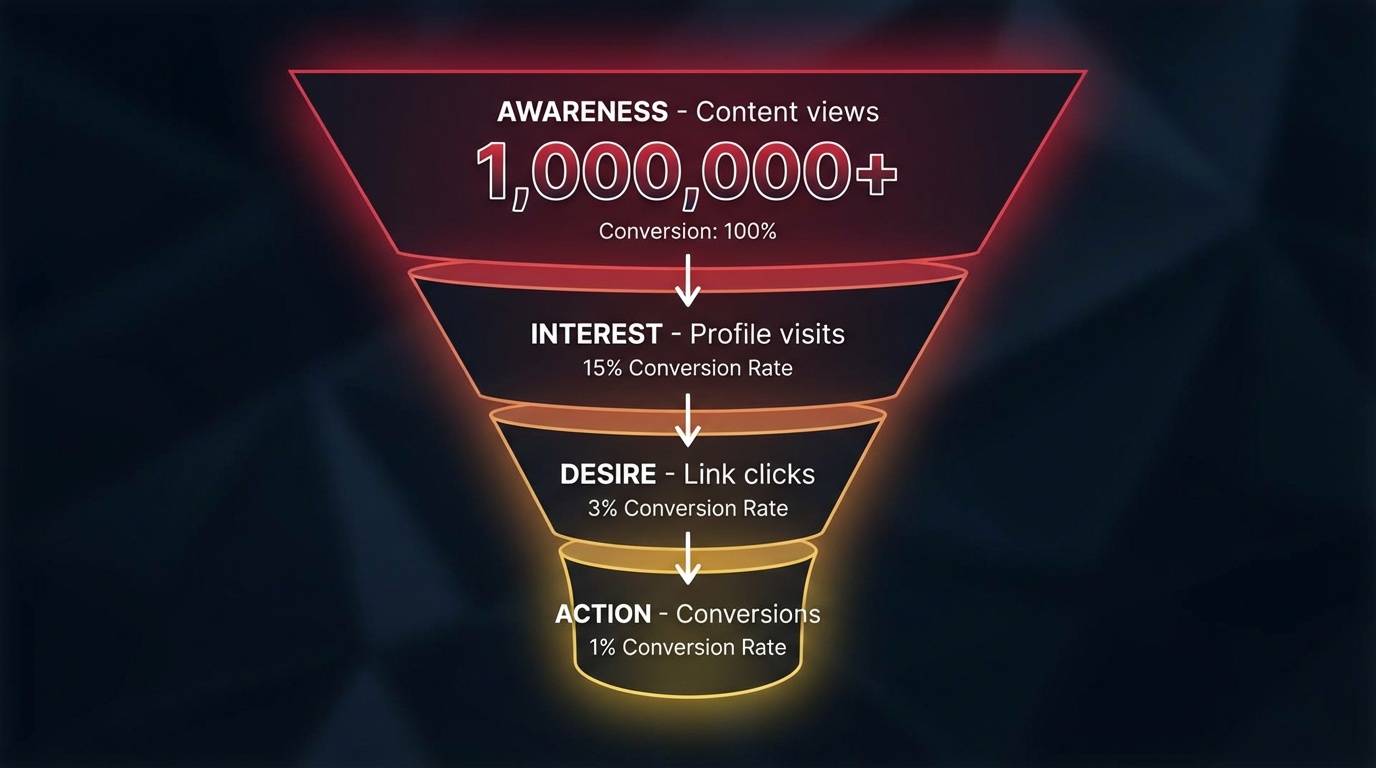
People don't just see one video and immediately download your app or buy your product. Most people need 7-10 touchpoints before converting. Focus on moving people through each stage.
The conversion funnel maps the journey from stranger to customer. Understanding this journey helps you optimize each step and identify where people drop off. Most creators only focus on the top (getting views) and completely ignore the middle and bottom where actual revenue happens. For a comprehensive framework on managing the full customer journey, see our guide on the LSDCP full-funnel marketing framework.
Stage 1: Awareness. They discover your content through the For You Page, Explore, or search. This is their first exposure to your brand-they're learning what you're about, whether your content resonates, and if you're worth following. Your goal at this stage isn't conversion-it's making a memorable first impression that encourages them to watch more.
Stage 2: Interest. Now they're watching multiple videos, following your account, and engaging with your content. They've decided you're interesting enough to see more. This stage is about building trust and demonstrating consistent value. They're evaluating whether you're a one-hit wonder or someone worth their continued attention.
Stage 3: Consideration. They're actively exploring your offer. They click your link in bio, visit your website or app, and learn about what you're selling or offering. This is the critical transition from audience to prospect. Most drop-off happens here because the transition from content to offer is jarring or unclear.
Stage 4: Conversion. They download your app, purchase your product, sign up for your service, or join your community. They've moved from viewer to customer. This is where revenue happens, but it's the culmination of all previous stages done correctly-you can't skip straight here.
Stage 5: Advocacy. They love your product enough to recommend it to others and create user-generated content about you. This is the ultimate goal-customers who become promoters. They're bringing you new awareness-stage prospects, creating a self-sustaining growth loop.
Most people need 7-10 touchpoints before converting. That means watching 7-10 of your videos, seeing your product mentioned multiple times, and developing trust in you over days or weeks. Don't expect instant conversions. The funnel is a process, not an event. Optimize each stage independently, then optimize the transitions between stages.
Important: Most people need 7-10 touchpoints before converting. They need to watch 7-10 of your videos, see your product mentioned multiple times, and develop trust in you. Don't expect instant conversions.
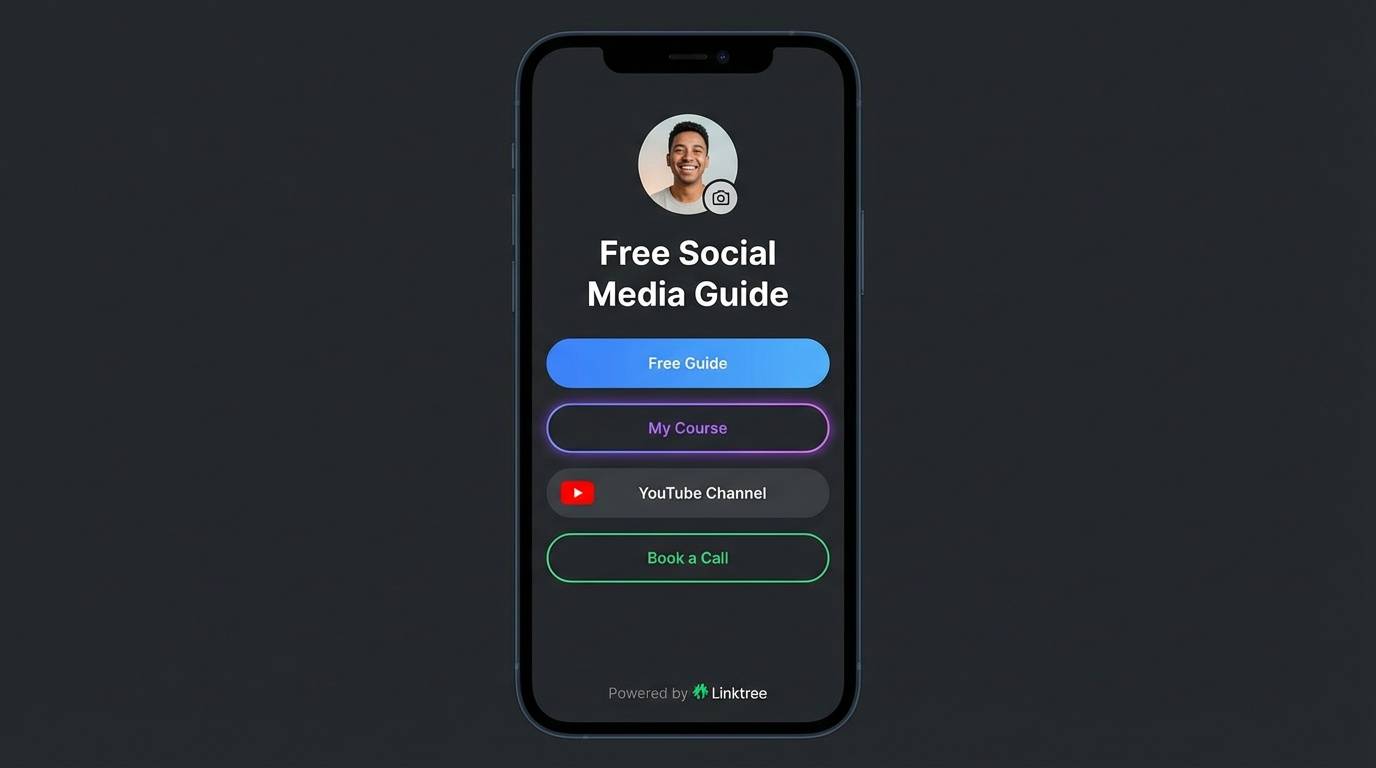
Your link in bio is the critical bridge between content and conversion. Optimize your bio for clicks with a clear value proposition and specific benefit.
Your bio is prime real estate-it's the first thing people see when they visit your profile, deciding whether to follow or click through. Yet most creators waste it with generic descriptions that communicate nothing about value.
Bad bios are vague and self-centered: "Content creator | DM for collabs | Link below 👇" tells me what you are, not what I get. Why should I click? What's in it for me? There's no value proposition, no specific benefit, no reason to take action.
Good bios lead with value for the viewer: "Helping busy creators edit faster ⚡ Try our AI editor (free) 👇" immediately tells me what you do for me (help me edit faster), how (AI editor), and the barrier to entry (free). It's specific, benefit-focused, and removes friction with "free."
The formula for an effective bio: Clear value proposition (what you help with) + Specific benefit (the outcome they get) + Call-to-action (what to do next) + Low barrier (free, no signup, instant access). Every word should serve one of these purposes. Cut everything else.
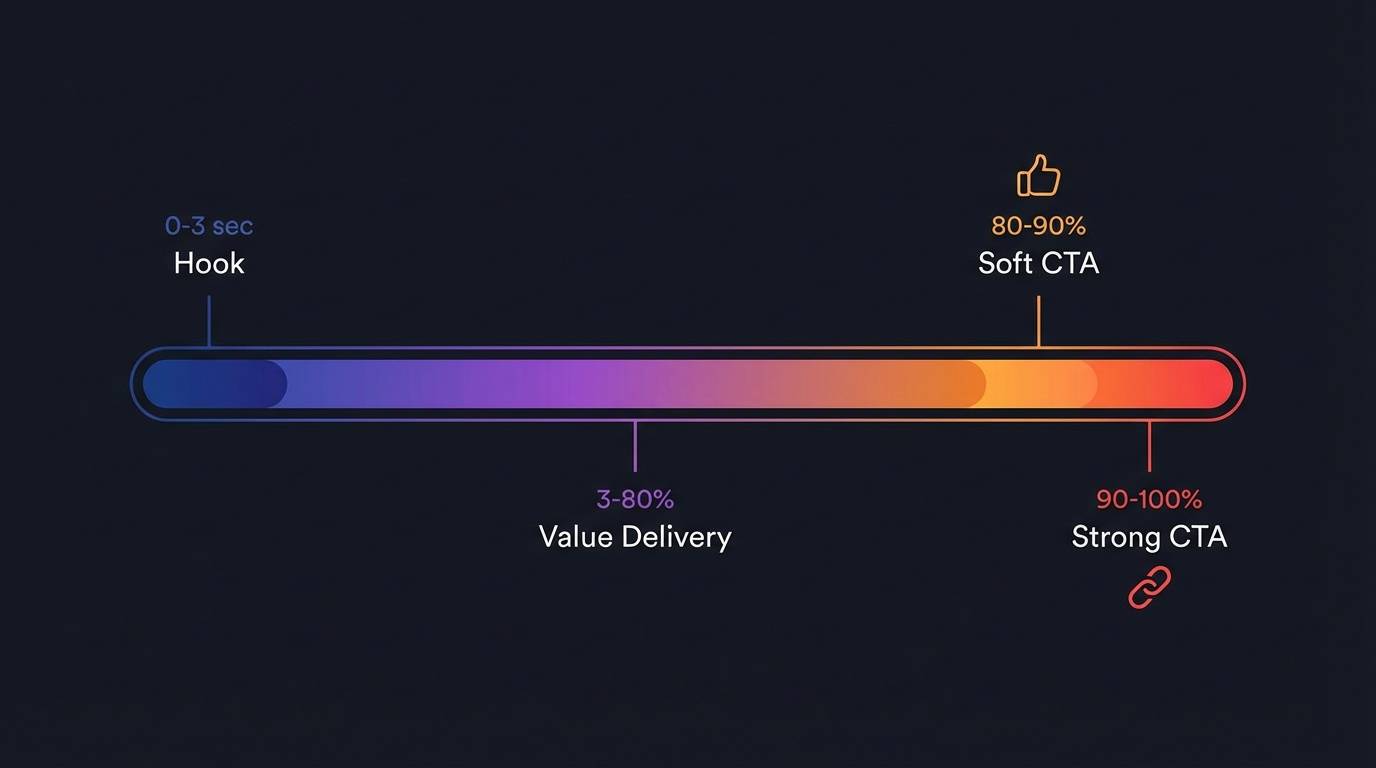
Not every video needs a CTA. Strategic placement (1-2 out of every 10 posts have direct CTA) works better than constant selling.
Most creators either never include CTAs (missing conversion opportunities) or include them in every video (coming across as pushy and hurting engagement). The strategic approach is finding the balance-frequent enough to convert interested viewers, infrequent enough to maintain trust.
Soft CTAs (use frequently): These are gentle reminders that don't feel salesy. "Link in bio for more details" or "I use [product name] for this" casually mention your offer without pushing. Use these in 30-40% of your videos. They convert viewers who are already interested while not alienating those who aren't ready yet.
Medium CTAs (use occasionally): These are more direct but still valuable-focused. "Download the app to try this yourself" or "Try this free tool I built" explicitly ask for action but emphasize the value they'll get. Use these in 10-20% of your videos, typically your best-performing content formats where viewer intent is highest.
Hard CTAs (use sparingly): These are aggressive conversion-focused asks. "Buy now," "Limited time offer," "Get 50% off today" create urgency and push for immediate action. Use these in less than 5% of your videos, typically during launches, promotions, or when you have a genuinely time-limited offer. Overuse destroys trust.
CTA best practices: Be specific rather than vague. "Download the free template (link in bio)" is better than "Check the link in bio." Create authentic urgency when applicable-"Early access closes Friday" works if it's true. Remove friction by emphasizing "No credit card required" or "Free forever." These small phrases dramatically increase conversion by reducing perceived risk.
Test different CTA types and track which drives the most action for your audience. Some audiences respond to direct asks, others to subtle mentions. Let data guide your CTA strategy rather than assumptions.
Track metrics at every stage of the funnel. Use UTM parameters and different links for each platform to understand what's working and what isn't.
You can't optimize what you don't measure. Most creators have no idea which videos drive traffic, which platforms convert best, or where people drop off in their funnel. They're flying blind, making decisions based on gut feeling rather than data.
Top of Funnel Metrics: Track video views (reach), profile visits (interest), and follower growth (commitment to see more). These awareness metrics tell you how effectively you're capturing attention. If views are high but profile visits are low, your content isn't compelling enough to make people want more. If profile visits are high but follower growth is low, your profile doesn't clearly communicate value.
Middle of Funnel Metrics: Monitor link clicks from bio (intent), website visits (consideration), and email signups (qualification). These metrics show how well you're transitioning interested viewers into prospects. Low link clicks despite high followers means your bio isn't compelling. High website visits but low signups means your landing page isn't optimized.
Bottom of Funnel Metrics: Measure app downloads, trial starts, purchases, and revenue by source. These conversion metrics are what actually matter for your business. Everything else is vanity if it doesn't eventually lead to revenue. Track revenue per platform, per content type, and per campaign to understand your true ROI.
Attribution tracking is essential. Use UTM parameters in all your links: yoursite.com?utm_source=tiktok&utm_medium=bio&utm_campaign=hook_video. This tells you exactly which traffic came from where. Use platform-specific links (link.com/tiktok vs link.com/instagram) to easily identify sources. Track which specific videos drive the most clicks using unique links or UTM campaigns.
The key questions your tracking should answer: Which videos drive the most link clicks? Which platforms convert viewers to customers at the highest rate? What's the average time from first view to conversion? Where do people drop off in your funnel? These insights direct where to invest your optimization efforts.
Certain content types drive more conversions than others. Focus on these high-converting formats.
Not all content converts equally. Entertainment content gets views but rarely drives action. Educational content with clear product integration converts far more effectively because you're demonstrating value while showing the solution.
Problem-aware content addresses specific pain points your audience faces and positions your product as the solution. "Struggling with [problem]? Here's how I solved it with [product]" works because you're meeting people where they are-they have the problem, you have the solution. The content provides value even without the product (you're solving their problem), which builds trust for the CTA.
Tutorial content shows exactly how to use your product to achieve a specific result. "How to [outcome] using [product] in 60 seconds" demonstrates value before asking for conversion. Viewers see the product working, understand how to use it, and can imagine themselves getting the same results. Tutorials convert because they reduce uncertainty and friction.
Results content showcases before/after transformations or specific, measurable outcomes. "I used [product] for 30 days-here's what happened" leverages social proof and results-focused storytelling. Specific numbers ("lost 15 pounds" or "gained 1000 followers") are more compelling than vague claims ("got results"). Results content converts because it provides evidence the product works.
Social proof content features testimonials, user-generated content, or milestone achievements. "10,000+ users" or "Here's what customers are saying" builds credibility through community validation. People trust other people more than they trust brands. UGC (user-generated content) is particularly powerful because it's authentic third-party validation.
Every extra step in your funnel loses people. Reduce friction by optimizing for mobile, simplifying forms, and minimizing steps.
Every click, every form field, every extra step loses 20-40% of users. A five-step funnel with 70% completion per step means only 17% of people who start actually finish (0.7^5). Your goal is ruthlessly cutting unnecessary steps and reducing friction at every stage.
Bad funnels are multi-step nightmares: Video → Bio link → Landing page → Sign-up form → Email verification → Finally download. Each step bleeds users. By the time someone reaches the download, you've lost 90% of the people who clicked the original link. Five steps is five opportunities to lose someone.
Good funnels are one-step miracles: Video → Direct app download link or instant access. Minimize steps between intention and action. If someone clicks your bio link, they should be one tap away from your product. The best funnels feel like zero friction-viewers go from interested to using your product in seconds, not minutes.
Optimize for mobile religiously. 90%+ of social media traffic is mobile. If your landing page takes 5+ seconds to load on mobile, most users bounce before seeing anything. Use large, finger-friendly buttons (44x44 pixels minimum). Keep forms simple-every field you require loses 5-10% of users. Use single sign-on options (Sign in with Google/Apple) to eliminate manual form filling.
Remove unnecessary steps. Question every step in your funnel: "Is this absolutely necessary?" If it's collecting information you don't immediately need, remove it. If it's explaining something that could be shown in the product, remove it. If it's building up anticipation, you're just creating drop-off points. The shortest path wins.
Build trust with social proof, guarantees, and authority markers. These signals reduce perceived risk and increase conversion rates.
People don't buy from brands they don't trust. Every new product involves risk-risk of wasting money, time, or looking foolish. Trust signals reduce perceived risk, making conversion easier.
Social proof leverages community validation: "10,000+ downloads," "4.8★ rating (1,200 reviews)," or customer testimonials with names and faces. Specific numbers are more credible than vague claims. "Join 10,347 creators" is better than "Join thousands." Video testimonials are more powerful than text because facial expressions and emotion are harder to fake.
Guarantees remove risk from the equation: "Money-back guarantee," "Cancel anytime," or "Free forever" signal confidence in your product. If you're willing to offer a guarantee, you must believe it works. Risk reversal (putting risk on you instead of the customer) dramatically increases conversion, especially for higher-priced products.
Authority establishes expertise: credentials (degree, certifications), press mentions ("As seen on..."), awards or recognition, or impressive results ("Helped 100+ businesses grow"). Authority signals answer the question "Why should I trust you?" Position yourself as an expert in your space through demonstrated expertise, not just self-proclaimed titles.
Test one variable at a time to identify what actually drives conversions. Measure results systematically and iterate continuously.
Most creators never test their funnel-they set it up once and hope it works. The best creators systematically test every element to maximize conversion rates. A 2% improvement in conversion can double your revenue if traffic stays constant.
Landing page elements to test: Headline variations (benefit-focused vs. feature-focused), CTA text ("Get Started" vs. "Try Free" vs. "Download Now"), page layout (video-first vs. text-first vs. social-proof-first), images or videos (product demo vs. results showcase vs. founder story). Test one element at a time so you know what drove the change.
Link in bio variations: Different value propositions (speed vs. quality vs. ease), CTA phrasing ("Free tool" vs. "Free resources" vs. "Free training"), inclusion of specific numbers or outcomes. Your bio is often your highest-traffic page-small improvements here create outsized impact.
Content CTA variations: Different phrasing (question vs. command vs. suggestion), timing (beginning vs. middle vs. end), soft vs. hard CTAs. Track which drives the most link clicks and optimize for the highest-converting styles.
The key to effective testing is isolation-change one variable at a time so you know what caused the result. Test for at least 100 conversions or one week (whichever comes first) to ensure statistical significance. Document your tests and learnings so you build institutional knowledge over time.
Most people need 7-10 touchpoints before converting. This means watching 7-10 of your videos, seeing your product mentioned multiple times, and developing trust over days or weeks. Don't expect instant conversions—the funnel is a process, not an event.
Use soft CTAs ('Link in bio') in 30-40% of videos, medium CTAs ('Download the app') in 10-20%, and hard CTAs ('Buy now') in less than 5%. Strategic placement works better than constant selling—too many CTAs destroy trust.
Reduce friction. Every click, form field, and extra step loses 20-40% of users. A five-step funnel with 70% completion per step means only 17% finish. Minimize steps between intention and action—the best funnels feel like zero friction.