The Viral Formula
Master the viral formula: Hook, Value, Emotion, CTA framework.
8 min
Loading...
Ready to start automating?
Join hundreds businesses growing with Renderfire
Master the viral formula: Hook, Value, Emotion, CTA framework.
Join hundreds businesses growing with Renderfire
Viral content follows a formula: Hook (0-3 seconds) + Value (core content) + Emotion (throughout) + Call-to-Action (end). Use the 10/10/10 rule—post 10 pieces in a format, analyze the top 10%, then 10x down on what worked. Catch trends early (10K-50K uses) and adapt within 24-48 hours. Test one variable at a time to learn what drives results.
Key Insight: Viral content isn't about luck—it's about understanding your audience, leveraging proven patterns, and optimizing for platform algorithms. The most successful creators follow repeatable formulas that consistently generate views, even if every video doesn't go viral.
Every viral video follows this formula. Master these four components and you'll dramatically increase your chances of going viral.
Hook + Value + Emotion + Call-to-Action = Viral Potential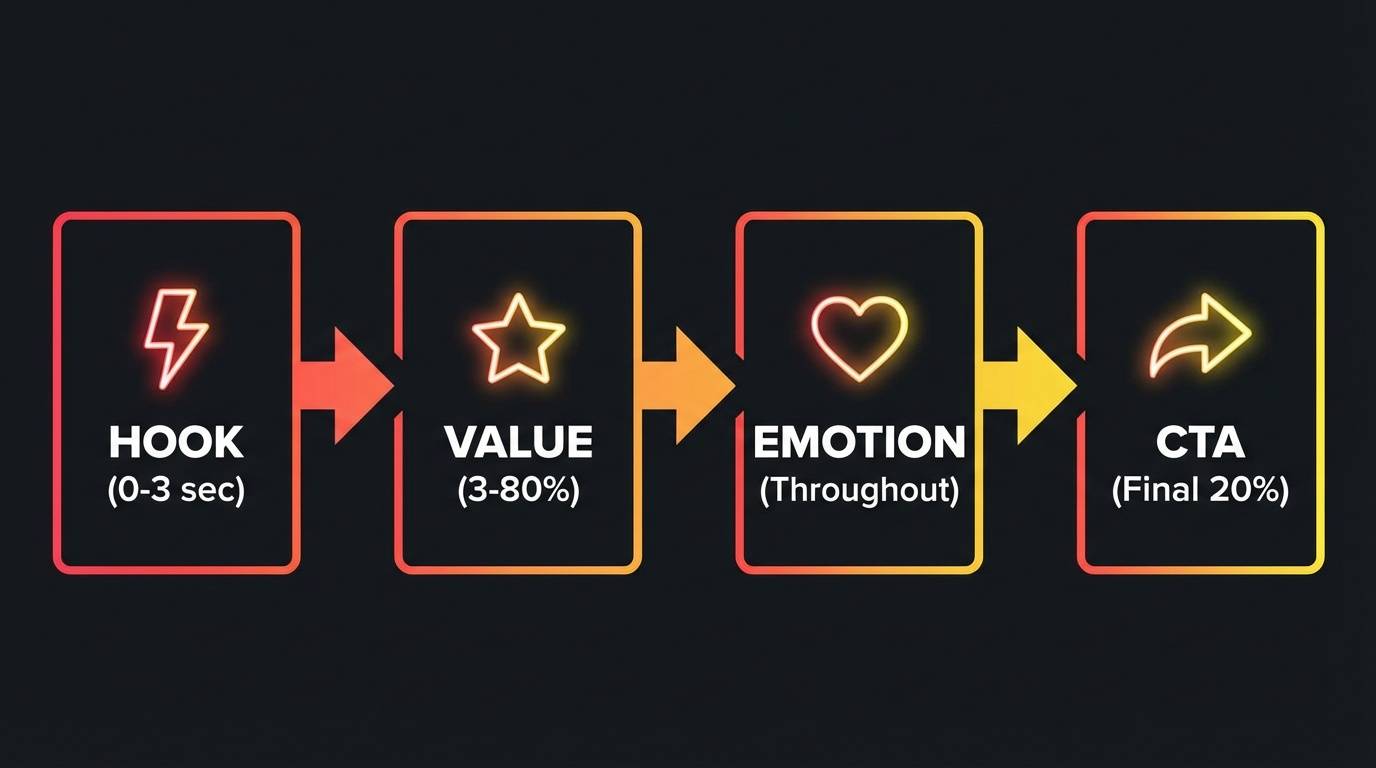
Hook (0-3 seconds): This is your make-or-break moment. In the first three seconds, viewers decide whether to keep watching or scroll away. Your hook must grab attention immediately with pattern interrupts-something unexpected, intriguing, or emotionally compelling. Don't waste time with introductions or slow build-ups. Start with your most interesting point, a surprising claim, a visual that stops the scroll, or a question that creates curiosity.
Value (3-80% mark): Once you've hooked them, deliver on your promise with practical information or entertainment. This is where you prove you're worth their time. The content should move quickly-cut dead space, use jump cuts, add B-roll for visual interest. Every second should either educate, entertain, or build toward your conclusion. If a section doesn't serve a purpose, cut it.
Emotion (Throughout): Viral content makes people feel something. Curiosity ("How did they do that?"), surprise ("I never knew that!"), humor ("That's hilarious!"), inspiration ("I can do this too!"), or even righteous anger ("That's wrong!"). Emotional content gets shared because people want to pass that feeling to others. Flat, purely informational content rarely goes viral-you need emotional hooks throughout.
Call-to-Action (Final 20%): End with clear next steps for your audience. Like and follow for more content like this. Comment with their experience. Share if they found it valuable. Visit your profile for related resources. Don't be pushy, but do be clear-viewers often want to take action but need to be told what to do.
The hook is the most critical part of your content. It must grab attention immediately, create curiosity, and promise value viewers want.
Bold statements: "This changed everything for my business..." These statements create instant curiosity. What changed? Why was it so impactful? Viewers keep watching to find out. The key is making a claim strong enough to intrigue but authentic enough to believe.
Intriguing questions: "What if I told you this one mistake costs most creators 80% of their views?" Questions engage the brain differently than statements. They create a knowledge gap that viewers want filled. The question should be specific enough to promise value but open-ended enough to require watching for the answer.
Pattern interrupts: Unexpected visuals, unusual sounds, or surprising actions that break the scroll pattern. Your hand suddenly appearing in frame, a visual illusion, text that moves unexpectedly, contrasting colors that pop against the feed. These tricks exploit how our brains notice novelty and change.
Shocking facts: "97% of people don't know this simple trick..." Statistics and surprising facts create credibility and curiosity simultaneously. The viewer thinks "Am I one of the 97%? I should watch to find out." The more specific and surprising the fact, the better it works.
Direct address: "If you're struggling with low views, you need to hear this..." Speaking directly to a pain point makes viewers feel seen. When content addresses their specific problem in the first three seconds, they're far more likely to keep watching. It signals "This is for you" immediately.
Need help crafting attention-grabbing hooks? Try our free TikTok Hook Generator to get instant hook ideas tailored to your niche.
Momentum on new accounts helps get the ball rolling on ALL your videos. Timing matters with trends—catch them early for maximum impact.
Trends are powerful multipliers, especially for new accounts. When you use trending sounds, formats, or challenges, you're essentially borrowing authority from content that's already proven to work. The algorithm gives trending content a temporary boost, and you can ride that wave.
Finding the right trends: Look for sounds or formats with 10K-50K uses-this is the sweet spot where momentum is building but saturation hasn't hit yet. Content with under 10K uses might not gain traction. Content over 100K uses is often oversaturated, making it harder to stand out. The 10K-50K range gives you the perfect window.
Speed matters critically: Adapt trending content within 24 hours, 48 hours maximum. Trends move fast on short-form platforms. By day three or four, the algorithm has often moved on to newer trends. Set aside time daily to monitor trending content and quickly create your version when you spot an opportunity.
Adapt to your niche: Don't just copy trending content-adapt it to your specific audience and expertise. If there's a trending "day in the life" format, show a day in the life within your industry. If there's a trending dance, incorporate your product or message. The key is making the trend relevant to your audience while keeping the core elements that made it trend.
Balance with evergreen: Trending content should supplement your strategy, not replace it. Most of your content (80-90%) should be evergreen formats that you've proven work for your audience. Add 1-2 trending posts per week as a supplement to boost overall account visibility. Chasing every trend dilutes your brand and exhausts your creativity.
When a trending post performs well, it creates momentum that helps your next few posts too. The algorithm notices your account is getting above-average engagement and gives your subsequent content a slight boost. Use this momentum window strategically by posting your best evergreen content right after a trend succeeds.
The 10/10/10 Rule: Post 10 pieces of content using a specific format, analyze which 10% performed best, then 10x down on that winning format.
Most creators fail because they give up too early or change strategies too frequently. The 10/10/10 rule provides a systematic approach to finding what works. Choose a content format (tutorials, behind-the-scenes, quick tips, etc.) and commit to posting 10 versions of it. This gives you enough data to see patterns.
After 10 posts, analyze which performed best-typically the top 1-2 posts (the 10%). Study these winners carefully. What made them work? The hook? The specific topic? The pacing? The thumbnail? Timing? Don't guess-look at the data. High view-through rate means the content held attention. High shares mean emotional resonance. High saves mean practical value. Each metric tells you something different.
Then "10x down" on what worked. If tutorial-style content with fast pacing performed best, create 10 more pieces in that style. If videos about a specific sub-topic within your niche got the most engagement, dive deeper into that topic. The goal isn't to repeat the exact same video-it's to replicate the elements that made those videos succeed while varying the specific content.
Key metrics to track: View-through rate tells you if people watched to the end-the strongest signal for good content. Engagement rate (likes, comments, shares) shows emotional resonance. Click-through rate (for YouTube) indicates whether your title and thumbnail compelled the click. Save rate (especially on Instagram) shows if content provided lasting value worth revisiting. Share rate is the ultimate viral metric-people only share content they think will make them look good to their audience.
Test one variable at a time when possible. If you change the hook, the topic, and the pacing all at once, you won't know which change drove the results. Isolate variables to learn faster. Test different hooks with the same core content. Test different posting times with the same content type. Test different caption styles. Systematic testing beats random experimentation.
For businesses looking to test hooks faster without hours of filming, a TikTok AI video generator like Renderfire lets you connect your product and generate multiple content variations automatically-hook+demo videos, TikTok slideshows, UGC videos, and faceless video content. Whether you're learning how to make a slideshow on TikTok or scaling organic content, test different approaches to find what resonates, then use the TikTok Creative Center to identify trending formats and scale what works.
Before publishing, run through a quick checklist: Strong hook in first 3 seconds? Clear value proposition? Emotional trigger present? Trending elements incorporated when appropriate? Clear call-to-action at the end? Captions or subtitles added for accessibility? Relevant hashtags selected? Posted during your audience's peak hours? This checklist ensures consistency in quality.
Learn from what works and avoid what doesn't. These patterns make the difference between viral content and content that flops.
Follow this systematic 4-step workflow to create viral content efficiently. Time allocation matters—don't over-invest in any single phase.
Research & Planning (30%): This is where most creators underspend time and then wonder why their content flops. Identify what's trending in your niche right now-not last month, right now. Analyze top-performing competitors by studying their most successful videos from the past 30 days. What topics? What hooks? What format? Study successful content formats that you can adapt to your style. Plan your content calendar around a mix of trending and evergreen topics.
Creation (40%): Script your content using the viral formula (hook, value, emotion, CTA). Write it out, even for short-form video-winging it usually means weak hooks and rambling middle sections. Record multiple takes of your hook and opening since these are most critical. Capture B-roll footage that adds visual interest and can cover edits. Use quality equipment-you don't need expensive gear, but audio quality especially matters. Poor audio kills watch time fast.
Editing (20%): Cut aggressively. Remove every second of dead space, "um," long pauses, or slow sections. Add captions or text overlays-many viewers watch without sound, and text increases accessibility. Include pattern interrupts every 3-5 seconds to maintain attention: zoom, cut to B-roll, add text, change angle. Use trending sounds when appropriate. Keep pace fast, especially in the first 15 seconds.
Optimization (10%): Write compelling titles or captions that incorporate the hook from your video. Design thumbnails (for YouTube) that use high contrast, clear text, and emotional expressions. Choose hashtags strategically-a mix of sizes, all relevant to your actual content. Schedule posts for optimal times based on your analytics. Add any platform-specific optimizations (YouTube tags, Instagram alt text, etc.).
The time allocation is crucial. Most creators spend too much time on production and editing, not enough on research and optimization. By front-loading research, you ensure you're making content people actually want. By optimizing posting, you give great content the best chance to succeed.

Take your content to the next level with these advanced strategies. Use them strategically to multiply your reach and engagement.
Controversy (use carefully): Taking contrarian positions drives engagement because people love to agree or argue. "Everyone says X, but here's why Y is actually true." Back your contrarian stance with logic and evidence-random hot takes without substance damage credibility. Be respectful even when disagreeing-the goal is discussion, not burning bridges. Controversy generates comments and shares, both strong algorithm signals.
Storytelling: Structure content using the hero's journey: problem, struggle, transformation, result. Personal stories and authentic experiences resonate far more than generic advice. Include specific details-"I lost $10,000 in my first month" lands harder than "I lost money." Build emotional arcs that make viewers feel invested in the outcome. Great stories get shared because they're memorable and relatable. This authentic storytelling approach is the foundation of effective UGC marketing on TikTok.
Collaboration: Duet or stitch popular content to ride algorithmic waves and tap into existing audiences. Collaborate with creators in your niche who have similar audience sizes-mutual benefit increases both parties' motivation. Tag relevant accounts and creators when appropriate (but don't spam tags). Collaboration exposes you to new audiences who are pre-qualified as interested in your niche. For more strategies on working with creators, check out our creator collaboration playbook.
Series & Continuity: Multi-part content keeps viewers coming back. "Part 1 of 3" in your caption creates anticipation and guarantees return viewers. Recurring formats make content production easier and build audience expectations-"Every Monday I break down a viral video." Reference previous videos to reward loyal followers and encourage binge-watching. Series and continuity build habit among your audience.
Quick reminders for each platform's unique requirements and best practices.
YouTube: Your title and thumbnail are 50% of success-they determine click-through rate, which heavily influences the algorithm. Make titles searchable by including keywords people actually search for. Create thumbnails with high contrast, clear text, and emotional facial expressions. The first 30 seconds determine audience retention, which is the other 50% of success. Front-load value and hook viewers immediately before diving into content.
TikTok: The first second (not three, one) is make or break. TikTok users scroll faster than any other platform. Use trending sounds from TikTok's library because the algorithm gives them a boost. Add captions or text overlays since many watch muted. Post consistently-daily is ideal on TikTok because the For You Page favors active accounts.
Instagram: Visual quality matters most on Instagram-lighting, composition, and aesthetic consistency matter more than on other platforms. Use all content types (Reels for reach, Feed for curated content, Stories for daily touchpoints) to maximize visibility. Reels currently get the highest organic reach, so prioritize them. Focus on the Save metric-Instagram's algorithm heavily weights saves as a quality signal.
Your hook should capture attention in the first 1-3 seconds. On TikTok, you have about 1 second before users scroll. On Instagram, 1-2 seconds. On YouTube, up to 3 seconds. Start with your most compelling point—never waste time on introductions like 'Hey guys, welcome back.'
Jump on trends when they have 10K-50K uses—this is the sweet spot where momentum is building but saturation hasn't hit. Content with under 10K uses might not gain traction. Over 100K uses is often oversaturated. Adapt trending content within 24-48 hours maximum—by day three or four, the algorithm has moved on.
Use the 10/10/10 rule: Post 10 pieces in a specific format, analyze which 10% performed best, then 10x down on that format. Most creators find their breakthrough format between videos 50-150. Don't give up after 10-20 posts—you haven't tested enough yet.
Creating viral content is powerful, but it's part of a bigger strategy. Combine these tactics with consistent posting, authentic engagement, and smart product integration for sustainable growth. One viral video can launch your channel, but consistent quality content sustains it. For platform-specific strategies, check our TikTok, Instagram, and YouTube best practices guides.